• Publications
    • Books
    • Opinions
    • Analyses
    • Reports
  • Events
  • About
    • SETA DC
    • People
  • US-Türkiye Relations
  • Washington Gündemi
  • Contact
  • info@setadc.org
    202-223-9885
    1025 Connecticut Ave NW
    Suite 410
    Washington, DC 20036
  • Publications
    • Books
    • Opinions
    • Analyses
    • Reports
  • Events
  • About
    • SETA DC
    • People
  • US-Türkiye Relations
  • Washington Gündemi
  • Contact

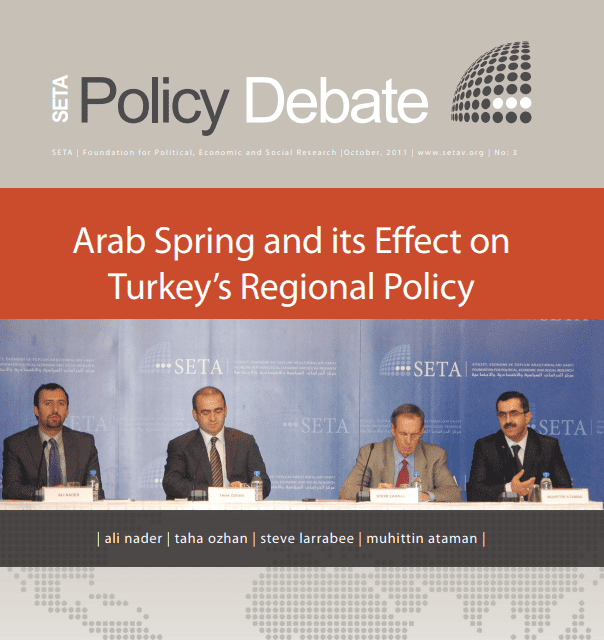
Arab Spring and its Effect on Turkey’s Regional Policy
SETA Foundation SETA DC Posted On October 25, 2011
0


By Ali Nader, Taha Ozhan, Steve Larrabee & Muhittin Ataman

Download the Policy Debate

Recent Arab revolutions have brought both opportunities and challenges to Turkish foreign policy.

As a country enjoying high popularity on Arab streets, Turkey has increased its profile in the region due to its robust economic growth and political transformation by consolidating democracy addressing long overdue questions.

Under the ambitious zero problems with neighbours policy Turkey had also expanded contacts with many of the Arab regimes in the region. However, as Arab Spring knocked on the doors of Turkey’s immediate neighbourhood –Syria-, it became clear that Turkey’s zero problems with neighbours policy needs to be reconsidered in a way that would take into account people’s aspirations for rights and freedoms. Turkey’s position, in this respect, will have decisive impact on regional power balances between Turkey, Iran and Arab world in post-Arab Spring period.

SETA’s public seminar ‘’Arab spring and its effect on Turkey’s regional policy’’ brought together Steve Larrabee of RAND Corporation, Ali Nader of RAND Corporation and Muhittin Ataman of SETA Foundation, to discuss further the implications of Arab spring on regional and international power balances in general, and on Turkish foreign policy in particular. The panelists addressed the following questions: What role can Turkey play in the region? How would Arab Spring affect Turkey’s neighbourhood policy, especially its relations with Iran? How will Turkey’s lowering relations with Syria affect Turkish-Iranian relations, and what meaning will it entail for the region?

  • Recent

    • Panel on Middle East Developments and the Future of Türkiye–Japan...
      April 21, 2026
    • “Strategic Implications of the Iran War” panel...
      March 30, 2026
    • ‘Any Given Sunday’: The clash of nationalism and multiculturalism...
      February 11, 2026
    • America’s Search for a Grand Strategy
      January 2, 2026
    • Türkiye Messages From the Trump-Netanyahu Press Conference
      December 30, 2025
    • A Window of Opportunity in Türkiye-U.S. Relations
      December 19, 2025
    • The End of the American Century? Interdependence, Soft...
      June 9, 2025
    • Trump-Netanyahu Relationship Takes a Turn for the Worse
      May 30, 2025
    • Why Is Trump Bypassing Israel?
      May 30, 2025
    • Israel’s plan to involve the United States in the occupation...
      May 30, 2025

  • Washington Gündemi

    • California’da Cami Saldırısı
      May 22, 2026
    • Trump'ın Etkisinde Ön Seçim Maratonu
      May 22, 2026
    • ABD-Çin İlişkilerinde Yeni Dönem
      May 22, 2026
    • İran Savaşında Kontrollü Gerilim
      May 22, 2026
    • Teknoloji Şirketlerinin Yeni Diplomatik Rolü
      May 15, 2026
    • Fed Başkanı Kevin Warsh Oldu
      May 15, 2026
    • ABD-İran Görüşmeleri Tıkanma Noktasında
      May 15, 2026
    • Washington-Pekin Hattında Yeni Denge Arayışı
      May 15, 2026
    • Musk'tan Sam Altman'a Dava
      May 8, 2026
    • Ara Seçimlere Doğru Yarış Kızışıyor
      May 8, 2026


Stay Updated


© Copyright 2018-2022 SETA Foundation at Washington DC
Press enter/return to begin your search