US Policy in the Middle East in Obama’s Second Term
There is a broad range of expectations from President Obama’s second term. Those who expect a dramatically different Middle East policy in his second term cite the unsustainability of the cautious involvement of the first term. Others argue that the US involvement will continue to be highly risk-averse. While the US sorely wants to avoid the high price of missteps and misadventures, the regional turmoil and uncertainty continue unabated, as the regional order is shaken to its core. How will the American position in the region look like over the next four years? What are the vital American interests that may trigger a stronger involvement? How can the US work with regional actors to address stability and legitimate governments simultaneously? What are the prospects of a more robust US role in the Middle East?
Speakers
Rob Malley, Program Director, Middle East and North Africa, International Crisis Group
Leila Hilal, Director, Middle East Task Force, New America Foundation
Trita Parsi, President, National Iranian American Council
Erol Cebeci, Executive Director, The SETA Foundation at Washington DC
Moderator
Kadir Ustun, Research Director, The SETA Foundation at Washington DC
Event Summary
by Rory Donnelly
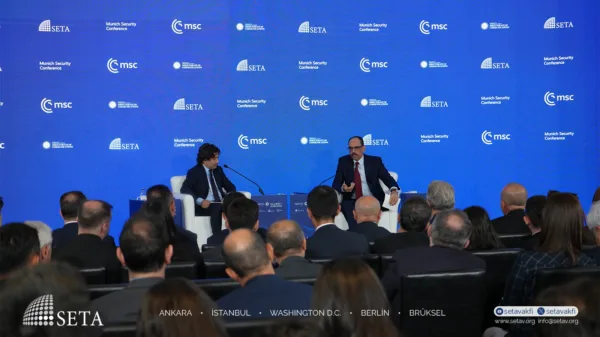
The panelists discussed US Middle East policy during the first Obama administration, as well as prospects for the second term. Robert Malley, Leila Hilal, and Erol Cebeci agreed that the Obama administration inherited a crisis in American leadership and influence in the region from the Bush administration. Hilal and Trita Parsi noted that the administration made ambitious but unsuccessful initiatives towards Iran and the Israeli-Palestinian conflict early on, with Parsi pointing out that Obama backed down in the face of Congressional and other opposition. On the Arab Spring, Cebeci noted that the administration’s cautious response so far may be suitable for a transitional period, but is unsustainable in the long run. Malley and Hilal warned against a “nostalgic” approach to the Israeli-Palestinian peace process that ignores new realities on the ground, Malley opposed a special relationship with the Muslim Brotherhood that turns it into a real or perceived “new Mubarak,” and Parsi cautioned that an ultimatum from the US would derail negotiations with Iran. Hilal and Malley proposed that US strategic interests and approaches to regional issues be reassessed based on the lessons of the last twelve years and the implications of the Arab Spring, though Hilal and Parsi noted that organizational and bureaucratic interests in Washington will impede major policy shifts.
Asked for their top policy recommendations for the second term, Cebeci argued that, given the ongoing democratic transition in the region, the US should continue to have an open-minded approach to the Middle East and take into account Arab public opinion while making policy. Parsi stressed the importance of US diplomacy with Tehran, arguing that bilateral talks offer the best chance of success, while the failure of diplomacy would limit future US policy options to the detriment of all parties. He also warned against starting any new regional initiative without fully committing to it. Hilal maintained that the US should take a more hands-off approach to the region and become comfortable with the limits of its capacity to determine outcomes. Malley warned that the US should avoid getting sucked into sectarian or ethnically-based confrontations in which it has no stake of its own.