Panel on Middle East Developments and the Future of Türkiye–Japan Relations Held in Tokyo
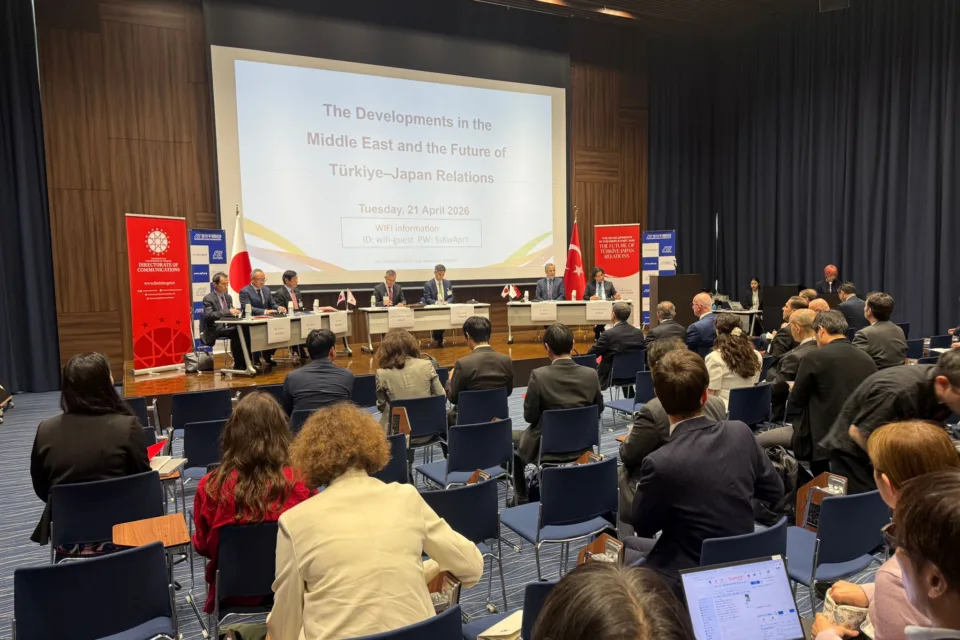
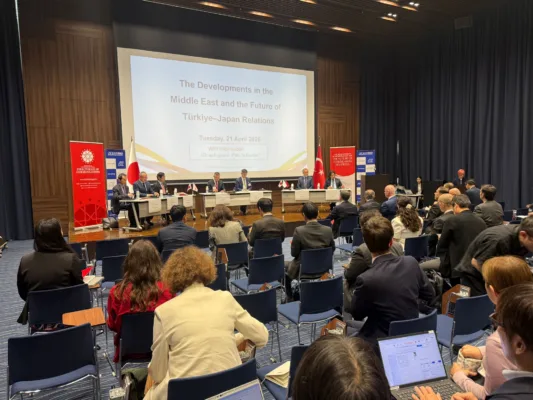
On 21 April 2026, the Presidency’s Directorate of Communications, the Foundation for Political, Economic and Social Research (SETA), and the Sasakawa Peace Foundation jointly organised a high-level programme in Tokyo titled “The Developments in the Middle East and the Future of Türkiye–Japan Relations.” The event, hosted by the Sasakawa Peace Foundation, brought together leading policymakers, academics, diplomats, and strategic experts to assess regional security developments and explore expanding bilateral cooperation between Türkiye and Japan.
The programme included a panel session, roundtable discussions, and media engagements, reflecting the growing strategic importance of Türkiye–Japan relations amid evolving geopolitical transformations. Opening remarks by Sasakawa Peace Foundation President Atsushi Sunami and Türkiye’s Ambassador to Japan Oğuzhan Ertuğrul highlighted the enduring historical friendship between the two countries and stressed the importance of strengthening cooperation in diplomacy, trade, science, and cultural exchange.
Participants underscored that historical milestones such as the Ertuğrul Frigate incident continue to serve as foundational symbols of solidarity, reinforcing bilateral ties that can now be expanded into new strategic sectors. As two significant powers situated at opposite ends of Asia, Türkiye and Japan were described as possessing complementary geopolitical, economic, and diplomatic capabilities.
The panel, moderated by Prof. Kılıç Buğra Kanat, featured extensive discussion on both regional security architecture and future bilateral opportunities. Speakers emphasised that Türkiye’s strategic role within NATO, coupled with its expanding defence industry capacity, positions Ankara as a key actor in broader international security frameworks. Türkiye’s contributions to NATO-compatible defence capabilities and regional stabilization were presented as critical assets in today’s shifting strategic environment.
Regional developments, particularly those centred on Iran and the broader Middle East, formed a central theme of the discussions. Experts noted that while regional power balances continue to shift, Türkiye’s capacity as a middle power enables it to act as both a stabilising force and an effective mediator in times of crisis. The importance of Türkiye’s regional ownership model—supporting locally driven conflict resolution while advocating institutional reform in global governance structures—was repeatedly emphasised.
Speakers also highlighted that Japan’s diplomatic preference for peace, de-escalation, and development aligns with Türkiye’s strategic emphasis on regional stability. This convergence creates opportunities for enhanced cooperation not only in defence and security but also in economic investment, infrastructure development, education, tourism, and technological innovation.
Former Japanese Ambassador to Ankara Akio Miyajima stressed that expanding defence, infrastructure, and educational cooperation would strengthen both bilateral relations and broader regional security. Similarly, Japanese and Turkish experts pointed to the strategic value of institutionalising think tank partnerships, policy coordination, and academic exchanges to create a more sustainable framework for long-term cooperation.
Economic transformation and emerging global investment opportunities were also identified as key areas where Türkiye and Japan can deepen strategic engagement, particularly through joint projects in developing regions and collaborative trade initiatives.
A recurring theme throughout the event was the importance of people-to-people diplomacy. Strengthening academic ties, youth exchanges, and broader cultural initiatives were presented as essential pillars for ensuring that Türkiye–Japan relations continue to evolve beyond traditional diplomatic channels into a multidimensional strategic partnership.
The programme concluded by reaffirming that Türkiye–Japan cooperation has substantial untapped potential across political, economic, security, and societal dimensions. By fostering deeper strategic dialogue and institutional collaboration, both countries are well-positioned to contribute meaningfully to regional stability, global governance reform, and international peacebuilding efforts in an increasingly multipolar world.
You may also like