Why Vladimir Putin praises the Turkish president

Two news stories with completely opposite titles appeared in Western media last week. The first story was about Turkey allegedly provoking its NATO allies by testing the S-400 air defense system. The other related to Ukrainian President Volodymyr Zelensky’s remarks on the “unprecedented” level of cooperation between Turkey and Ukraine, viewing the Ukrainian leader’s decision to award President Recep Tayyip Erdoğan with the medal of honor as problematic for Russia’s President Vladimir Putin. That development, The Times argued, could be detrimental to Erdoğan’s relationship with Putin.
Judging by those two headlines, Turkey would appear to be experiencing tensions with the United States and Russia simultaneously. Indeed, it seems that the balance it struck in its relations with the two great powers could be lost at any moment.
In truth, however, the situation is on a completely different level.
Today, tensions or rivalry between the two nations do not necessarily exclude opportunities for cooperation. Turkey had to learn about this new kind of relationship, entailed by the new realities of the international system, as a result of several crises it experienced since 2013.
Due to the new trajectory of the Syrian civil war and a 2016 coup attempt, the Turkish government adopted a new approach in its dealings with the West and Russia alike. That fresh and dynamic policy, which sanctions limited use of hard power, is highly pragmatic and flexible. It is shaped by the productivity of the interplay between tensions, rivalry and cooperation.
For example, Turkey is cooperating with Russia over the TurkStream pipeline and the S-400 system, but that does not exclude competition between those countries in Ukraine, Nagorno-Karabakh, Libya and Idlib.
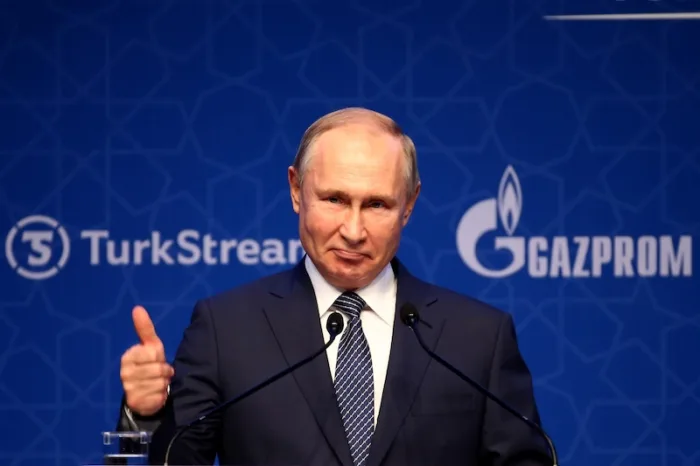
For the record, Putin perfectly appreciates this new brand of relationship. Hence his compliments for Erdoğan at a press conference on Friday. The Russian president noted that Turkey subscribes to an independent foreign policy despite outside pressures. He complained that Moscow could not complete energy projects with European governments as quickly as TurkStream became a reality. Recalling Erdoğan’s determination to buy the S-400 system, Putin said it was “pleasant and safe to work with such a partner.”
Western leaders, too, need to learn to appreciate what Putin recognized last week. Just as Turkey’s refusal to recognize Crimea’s annexation and its competition with Russia in Libya, Nagorno-Karabakh and elsewhere does not reflect anti-Russian sentiment, so too its decision to buy the S-400 system is not a sign of opposition to the West or NATO.
On one hand, Turkey’s discovery of natural gas in the Black Sea reduces its dependence on Russian energy. On the other, the conflict in Nagorno-Karabakh compels Moscow to work more closely with Ankara in the Caucasus. Indeed, Putin told reporters last week that he was not worried about Russia’s disagreements with Turkey over the South Caucasus region, stressing the need to find areas where concessions could be made. Erdoğan, in turn, reiterated his commitment to play some role, at the negotiating table and on the ground alike, by saying that Turkey also had a right to be there if Russia intended to be there for a peaceful solution. In other words, if Armenia wants Moscow, Azerbaijan calls for Ankara’s involvement and Russia seems to be ready to accept those terms.
Those assessments indicate that Ankara would like to remain part of the Western alliance but seeks a new kind of relationship with Russia, the United States and the European Union. Adapting to the new circumstances will create fresh opportunities for all parties. If President Donald Trump gets reelected on Nov. 3, he will stick to those terms. In case of a Joe Biden victory, the United States will assume a new role globally and by extension, revise its relationship with Europe, China and Russia.
For the record, one of the Western media’s favorite arguments, that Erdoğan stands to lose more than anyone in case of a Biden victory, is not true. The Democrats’ Middle East and Russia policies won’t just fuel tensions with Turkey. They could also generate fresh cooperation. Even the S-400 issue won’t necessarily translate into U.S. sanctions in the potential Biden presidency’s initial months. Going forward, there would be room for a new balance in the Turkey-U.S. relationship because Erdoğan and Biden know each other well enough. As such, it would be wise to compartmentalize Washington’s relations with Ankara and address the S-400 issue separately. Indeed, Turkey has done the same thing on a range of issues successfully.
The million-dollar question is as follows: Why did Putin sing Erdoğan’s praises? Was he perhaps anticipating future tensions between Russia and the United States?
This article was first published by Daily Sabah on October 26, 2020.
You may also like