The Samarkand Summit and Türkiye’s position
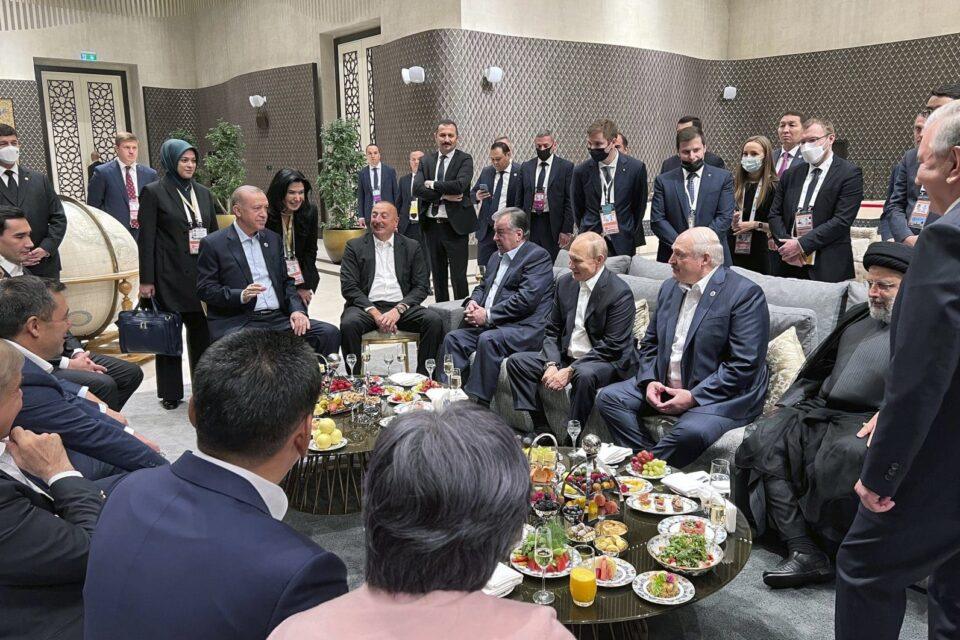
The Shanghai Cooperation Organization (SCO), which the Western media depict as an anti-Western alliance, continues its enlargement. The organization, which has nine members following Iran’s admission, recognized Egypt and Qatar as dialogue partners at the Samarkand Summit. At the same time, the SCO has launched processes related to the full membership of Belarus and granting “dialogue partner” status to Bahrain, Kuwait, the Maldives, the United Arab Emirates (UAE) and Myanmar.
It would make much more sense to think of the SCO’s enlargement as the “rise of the non-Western world” with Asia at its core. There is no doubt that Russia and China have not yet joined forces against the United States, with which they both compete. As Moscow’s relations with the West experience a major disruption, Beijing remains cautious despite the Taiwan crisis.
Indeed, another highlight of the Samarkand Summit was the first meeting between Russian President Vladimir Putin and the Chinese president, Xi Jinping, since the Ukraine war started. It appeared that the Russian leader could not receive as much support from Xi as he had expected in the face of U.S. and European Union sanctions. It is no secret that China is unhappy with the level of uncertainty and heightened risks that Moscow’s war has entailed in the international arena. In other words, it is obvious that the ideals of New Russia and New China follow two separate paths.
A new dimension and Alevi identity
The main opposition Republican People’s Party (CHP) chairperson, Kemal Kılıçdaroğlu, has been imposing his candidacy on the opposition bloc commonly known as the “table for six.”
Bülent Kuşoğlu, one of the CHP’s deputy chairpersons, recently said that one ought to think carefully about the meaning of rejecting Kılıçdaroğlu’s candidacy for Turkey’s future: “(Kılıçdaroğlu) is a hard-working, honest and experienced statesman. If he is not nominated despite that fact, it will be perceived as if he were rejected because he is Alevi. Neither our society nor our democracy can stomach that. In this sense, the table will be turned over if they oppose (Kılıçdaroğlu’s candidacy).”
That statement was a response to the opponents of Kılıçdaroğlu’s candidacy, within his own party and among the opposition ranks, due to his Alevi background as well as an attempt to force Meral Akşener, the Good Party’s (IP) chairperson, to stop making moves.
At the same time, it took the debate over Kılıçdaroğlu’s Alevi background to a new level, effectively questioning the democratic credentials of the opposition leaders.
In doing that, Kuşoğlu did not neglect to issue a threat to “turn over the table” either.
For some time, all opposition leaders, except Akşener, had been silent on Kılıçdaroğlu’s attempts to impose himself as the bloc’s joint presidential candidate. It would seem that the CHP came to manage the “table for six” through the threat of disintegrating the opposition bloc – in other words, the “survival syndrome.”
Daily Sabah, September 19, 2022
You may also like