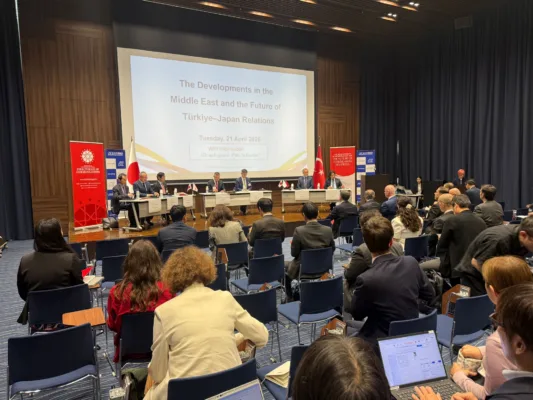
Insight Turkey 4th Annual Conference Welcome & Keynote & Panel I: Elections and the Future of Turkish Politics
9:30 – 9:45 – Welcoming Remarks
Talip Küçükcan (Insight Turkey)
09:45 – 10:45 – Keynote Address
H. E. Beşir Atalay (Deputy Prime Minister of Turkey)
Moderated by Erol Cebeci (SETA DC)
Panel I: Elections and the Future of Turkish Politics
Chair:
Kadir Üstün (SETA DC)
Speakers:
Hatem Ete (SETA Ankara)
Fuat Keyman (Sabancı University & Istanbul Policy Center)
Ertan Aydın (POLLMARK)
Etyen Mahçupyan (Zaman Daily)
Summary:
Hatem Ete discussed the local elections in the context of social and political developments in Turkey from June 2013 onward, thus giving the March 30 elections the feel and significance of general elections. He examined the effects of the Gezi Park protest and Gulenist-led operation on the eve of the elections alongside the actual election results, noting that the historical popularity of different political parties has remained largely the same. As such, Turkey may be interpreted as a nation of strong identity politics, in which 75% of voters vote based on their identity and 25% on party performance, which, consequently, results a status quo in Turkish politics.
Fuat Keyman examined the AK Party’s growing status as a “dominant party” in Turkey following the results of the local elections, which has three criteria: 1) establishing a cycle of dominance in three consecutive elections; 2) outdistancing the opposition parties; and 3) supporters of other parties have little faith that their party will win elections. As a result, the AK Party era can be classified as a harbinger of a new “New Turkey.” This Mr. Keyman attributed to the rise of a dominant party with a strong leader, a new state structure with a post-military and post-judiciary tutelage, and the emergence of urbanization, a new middle class, and a conservative modernity. He ended his discussion by looking at the challenges for this New Turkey, including the polarized nature of Turkish political society, its continued transition to democracy, and its diplomatic relations with the West. Mr. Keyman suggested that revitalizing Turkey’s EU accession process is essential for addressing these challenges.
Ertan Aydın described the March 30 elections as a “historic turning point” in Turkish politics, due to the important social and political developments that took place during the year prior, the resulting high electoral participation, and the diversity of candidates represented as a reflection of the “rich mosaic of the Turkish population.” He examined the AK Party’s victory despite the negative campaigning tactics of the opposition parties. Due to the nature of the local elections, Mr. Aydin characterized Turkish politics as regionally fragmented and a segmented two-party system. He also delved into an examination of the demographics behind the voting numbers, debunking assumptions about gender, age, and literacy across the various party supporters. Mr. Aydin concluded that the March 30 elections “shattered many myths” about Turkish politics.
Etyen Mahçupyan approached the question of how and why the AK Party received 45% of the March 30 votes against all odds. He attributed its victory not only to polarization, but also the transformation of the religious community and religiosity in Turkish society. Mr. Mahçupyan stated that there is a growing secularization within the religious community, where individuals redefine their personal beliefs and are increasingly tolerant. He argued that Turkey is experiencing a growth in the hybridization of families – insofar as the family is becoming the most important institution in Turkey – and the Islamic conservative community, resulting in a new middle class defined on sociocultural terms. Mr. Mahçupyan concluded that Kemalism is coming to end due to a soft popular revolution, where the periphery is coming into and transforming the center, making it likely that the AK Party will remain in power for 10-15 years.