Historical Roots of Modernization in Turkey
The Young Scholars on Turkey (YSOT) Program Presents:
In his presentation, Serdar Poyraz will provide a framework for a radical re-evaluation of the history of modernization in the late Ottoman Empire and Turkey. He argues that, historically, European vulgar materialist ideas affected how Ottoman and Turkish intellectuals thought about religion and society, ultimately paving the way for the radical reforms of Kemal Atatürk and the strict secularism of the early Turkish Republic. He demonstrates that the ideas of leading westernizing and secularizing thinkers, who were inspired by European materialism, provoked religious, philosophical and literary responses from conservative anti-materialist thinkers; whereas, the westernizers argued for the adoption of western modernity in toto. The conservative anti-materialist thinkers made a crucial distinction between the “material” and “spiritual” sides of western modernity: They were eager to adopt the material side of western modernity, but had reservations about adopting European ethics and secular attitudes toward religion. The results were two different and competing approaches to modernity in Turkish intellectual history, accompanied by great social tension, which continues to this day. The echoes of these diverging philosophical approaches to modernization, he argues, provide the necessary background to understand the contemporary discussions between the ruling Justice and Development Party (AKP) and its political critics, especially the Republican People’s Party (CHP).
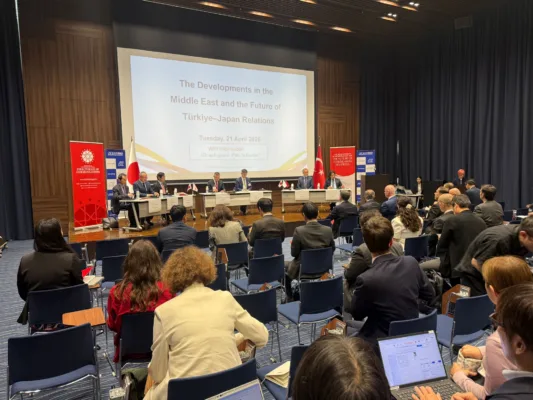
On Thursday, June 24th the SETA Foundation of Washington’s Young Scholars on Turkey program, a series jointly sponsored by the SETA Foundation and the Institute of Turkish Studies at Georgetown, hosted scholar Serdar Poyraz for a presentation and discussion on “Historical and Philosophical Roots of Modernization in Turkey.” Poyraz primarily focused on the theoretical framework of his doctoral dissertation, explaining such terms as “cultural authenticity” and “defensive developmentalism”. “Defensive developmentalism” is described as a society or government strengthening in the face of external threats, or influence, and managing internal resources within the state, and the public, he asserted. Poyraz went on to suggest that the intellectual elite of the period of late Ottoman Empire, did want to modernize, and yearned for “cultural authenticity”, but they wanted to modernize on their own terms. Europe and the West may have thought the idea of Turkey modernization was abstract, but for the modernizers of Turkey of that day it was seen as a concrete reality.
Poyraz’ central argument was that the division between ‘modernizers’ and ‘traditionalists’, voiced strongly by historians such as Bernard Lewis, is mistaken: For both westernizers and conservatives, a modernization of the Ottoman Empire was essential and without alternatives. Thus, the dispute was not about the value of modernization itself, but about the proper formulation of modernity in a non-European way. Whereas the westernizers argued for a full-scale adoption of western modernity, the traditionalists aimed to selectively adopt and utilize the material factors of European modernity.
“Turkey today is at the edge of a profound change”, Poyraz said. The old guard of the early Turkish republic has lost much of its power and a new elite is in formation. However, the question how this elite is going to shape Turkey in thefuture, still remains unanswered. Even though the new elite shows a democratic potential that has not been present before, it is yet unclear, which values it is going to represent.
Despite their many differences, the so-called traditionalists and modernizers in today’s Turkey still speak a common language – and that language is nationalism. The national narrative, evoked by the experience of immediate external threat in the Ottoman Empire, is still important in Turkey, Poyraz posited. However, it is increasingly challenged not to become radicalized in the face of the profound economic and political changes happening simultaneously. In the end, Poyraz argued, a new globalized and more liberal Turkey could emerge and replace the old, ethnic definition of being Turkish, and finally, he said, that democracy will inevitably become the common language of Turkey.