Implications of Turkey’s Local Elections
By Erol Cebeci & Kadir Ustun
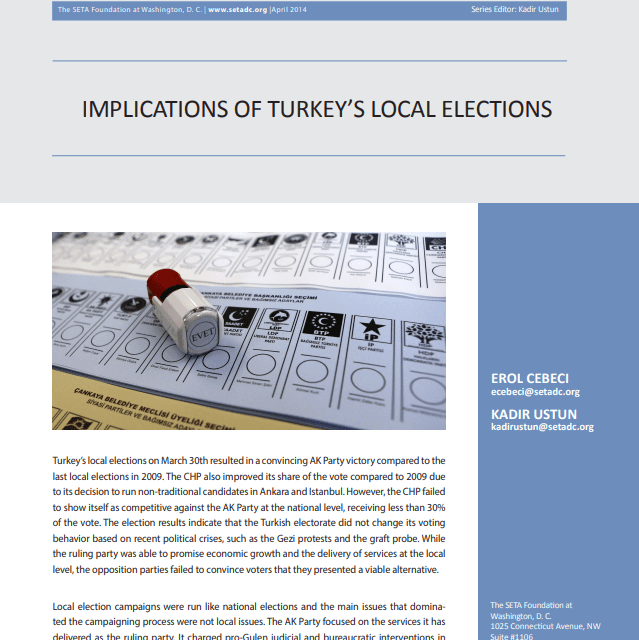
Turkey’s local elections on March 30th resulted in a convincing AK Party victory compared to the last local elections in 2009. The CHP also improved its share of the vote compared to 2009 due to its decision to run non-traditional candidates in Ankara and Istanbul. However, the CHP failed to show itself as competitive against the AK Party at the national level, receiving less than 30% of the vote. The election results indicate that the Turkish electorate did not change its voting behavior based on recent political crises, such as the Gezi protests and the graft probe. While the ruling party was able to promise economic growth and the delivery of services at the local level, the opposition parties failed to convince voters that they presented a viable alternative.
Local election campaigns were run like national elections and the main issues that dominated the campaigning process were not local issues. The AK Party focused on the services it has delivered as the ruling party. It charged pro-Gulen judicial and bureaucratic interventions in the political process as illegitimate attempts to engineer politics. The opposition parties tried to capitalize on the corruption allegations and perceived failures of Turkish democracy under the AK Party government. The election results show that the opposition cannot rely solely on the shortcomings of the ruling party, but needs to come up with a comprehensive political platform to be competitive. Further, they also show that political polarization was effective in mobilizing the masses, as a record number of voters went to the polls.
Election Results
The March 30th elections witnessed an unprecedented voter turnout (approaching 90%) for a local election. Unofficial results show that the ruling AK Party exceeded 45%, reflecting a 6-point increased from the 2009 local elections. The CHP’s share of the vote showed some improvement from the 2009 local elections but remained below 30%, a psychological threshold that would have shown the opposition party as competitive. The MHP made no significant gains except for victories in a few large cities, such as Mersin and Adana. The MHP and the CHP competed for votes from similar secularist and nationalist constituencies in the coastal regions. Even when they supported each other’s candidates, their success was limited and their votes insufficient to create a coalition block against the AK Party. The BDP held onto its traditional Kurdish vote with some inroads into the broader liberal constituency in the West. As expected, in the Kurdish majority cities there were no serious contenders other than the BDP and the AK Party, with the CHP and the MHP consistently falling below 3-5%… Continue Reading