The Trump Administration’s Post-JCPOA Iran Policy
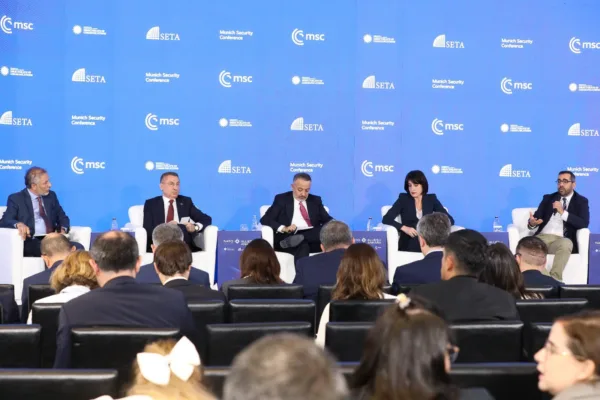
On June 13, SETA Foundation at Washington DC hosted the event “The Trump Administration’s Post-JCPOA Iran Policy.” The discussion focused on US-Iranian interactions in the future as well as US relations with its European and Middle Eastern allies. The panelists included Hussein Ibish, Senior Resident Scholar at the Arab Gulf States Institute in Washington; Reza Marashi, Research Director at the National Iranian American Council; Sigurd Neubauer, Middle East Analyst and Columnist; Barbara Slavin, Director of Future of Iran Initiative at the Atlantic Council; and, Randa Slim, Director of Conflict Resolution and Track II Dialogues Program at the Middle East Institute. Kilic Bugra Kanat, Research Director at the SETA Foundation at Washington DC moderated the event.
Reza Marashi opened the discussion commenting that the Trump administration has no policy nor strategy to renegotiate terms of the JCPOA after pulling out. Marashi briefly commented on the decision in 2013 of the Iranian government, when it evaluated three options: the first, to repair relations with the US and Europe; the second, to divide and conquer between Europe and the US; and the third, fall back on its actions of 2005. He argued that Iran is currently doing option two. He ended his comments by highlighting that Iran is searching for friends and partners on the foreign policy level and that the US has created an opening for Turkey and Russia.
Barbara Slavin then spoke about the US policy. She opined that one of the reasons Trump withdrew from the JCPOA was that he campaigned against it. Commenting on Pompeo’s speech, she argued that the US has unfortunately closed its communication channels with the Iranian senior government. She compared the Iran nuclear situation to that of North Korea, noting that the North Korean example was tailor made for Trump as there was one leader for him to work through decisions with. She contended that is not possible with Iran, as there are multiple high-level decision makers.
Hussein Ibish commented on the division of the GCC. He discussed the views of various countries in the region. Qatar needs to maintain a working relationship with Iran due to shared gas fields. Israel sees it as a major victory. The blockade has really made some countries happy. He argued that it will take months before the outcomes will be truly seen from the decision. He also mentioned the two separate working models that are coming from the administration. The first is a regime change led by Bolton and the second is a broader agreement led by Pompeo. He opined that a regime change is not possible from the outside.
Sigurd Neubauer disagreed with the other panelists, stating that there is a clear strategy from the Trump administration. He noted that at the core of the criticism for Iran is its foreign policy. He added that a divided Gulf provides Iran and Russia the opportunity to entangle themselves in the region, creating more instability. He stated that in the best case scenario, Arab states will not oppose a peace plan when presented. He commented that there is a change in the Israel-GCC relationship and argued that the strategic orientation seen is the President’s unpredictable style.
Randa Slim finished the discussion by stating that even when Iran was under sanctions, the world did not see them as effective because Iran has always had privatized sources of funding. Slim further discussed Iran’s actions in Yemen and Syria, highlighting its stance compared to Saudi Arabia. She also argued that the US and Saudi Arabia need to live with some Iranian influence, in certain places it will be higher than others. She mentioned that the major players in the region are going through the political bargaining game in certain countries.
The Trump Administration’s Post-JCPOA Iran Policy

You may also like