Second-wave of chaos in the Middle East
Our region is facing new crises every day and we expect that they will not subside, but rather continue to escalate for two main reasons. The first is the uncertainties, gaps and jumbles that the U.S.’s changing global role brings to the region and from the Pacific to Europe and the Middle East. In addition, the aggressive and inconsistent policies that the U.S. is resorting to for the protection of its economic interests are intensifying uncertainty.
The second is the emergence or formation of a power equation that will turn the tension in the Middle East into a hot battle. This destructive equation is being shaped by the superpower’s Middle East policy and competition between regional powers. The axis of polarization is between Iran and Gulf states dominated by Saudi Arabia. This polarization, which has turned into a black hole, is more deeply affecting the region.
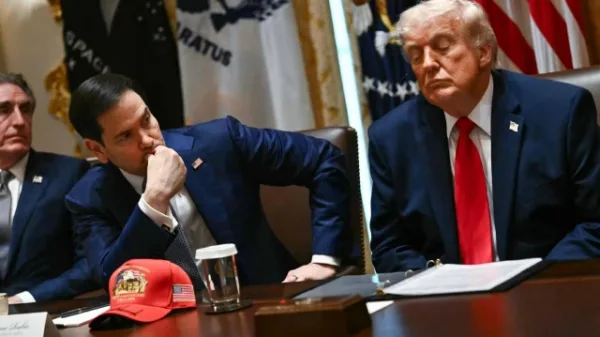
The problem is that Trump has neither a real plan to put a massive military presence in the region to limit Iran nor ideological and human capital, i.e., a proxy militia, that can fight against Iran.
First, it produced proxy wars and the Wahhabi-Shiite sectarian divergence. Now, it has created the possibility of a knock-down between Arab and Persian nationalities and the noble class going to a hot war through the distinction between “moderate and radical Islam”.
This turbulence also harms countries that are not involved in the polarization. The Gulf’s blockade on Qatar is just one example. Turkey, on the other hand, is an equilibrant that seeks diplomatic solutions through active mediation. As a matter of fact, President Recep Tayyip Erdoğan is visiting Russia, Kuwait and Qatar with the Saudi-Iranian tension on his agenda.
There are two countries that enjoy the deepening chaos of the Middle East. One is Russia, which has increased its influence by filling the gaps left by the U.S. after 2015. It has achieved regional power that affects the balances with a relatively limited military presence.
The other is Israel, which continues to take advantage of the weakening of regional powers at the risk of disintegration. It gained new advantages in the Syrian civil war, in the overthrow of President Mohammed Morsi in Egypt, in the case of Daesh’s acquisition of Iraq and Syria, in the struggle with Daesh, and as a result of Hamas having to accept to reconcile, in the Qatar crisis at no cost.
Now, it aims to weaken Hezbollah, which has gained strength as a result of the Syrian civil war with the unification of the whole region against Iran. The Middle East has not just forgotten the Palestinian-Israeli conflict. Gulf states are expanding the framework of cooperation with Israel by following in the footsteps of the United Arab Emirates.
Saudi-Iranian tension in recent days is actually the second wave of chaos in the region. It started with the Qatar crisis soon after U.S. President Donald Trump’s Riyadh summit in May gained momentum with Trump’s announcement of his Iran strategy and now continues with the resignation of Lebanese Prime Minister Saad Hariri. For this reason, I call this new wave the Trump effect during the Qatar crisis.
Former President Barack Obama’s effect had created the first wave. As can be remembered, Obama had supported the repression of Arab rebellions by status quo forces, resulting in civil wars in Libya, Syria and Yemen and then general and now President Abdel-Fattah el-Sissi’s coup in Egypt. Moreover, he tried to include Iran in the system through the nuclear deal. This led to the expansion of Iran and intensified Salafist Wahhabi-Shiite polarization in the region.
Trump, however, is directly doing what Obama had done indirectly with the strategy of limiting Iran. He is fostering Saudi fears and ambitions and is pushing Iran to a more aggressive attitude in the name of defense and resistance. He takes care of his own economic interests on issues such as arms and energy sales.
The problem is that Trump has neither a real plan to put a massive military presence in the region to limit Iran nor ideological and human capital, i.e., a proxy militia, that can fight against Iran. The other possibility is long and chaotic conflicts. Iran knows how to reckon this and Israel knows how to utilize this.
This article was first published by Daily Sabah on November 16, 2017.