Türkiye’s place in NATO questioned amid provocations in Europe
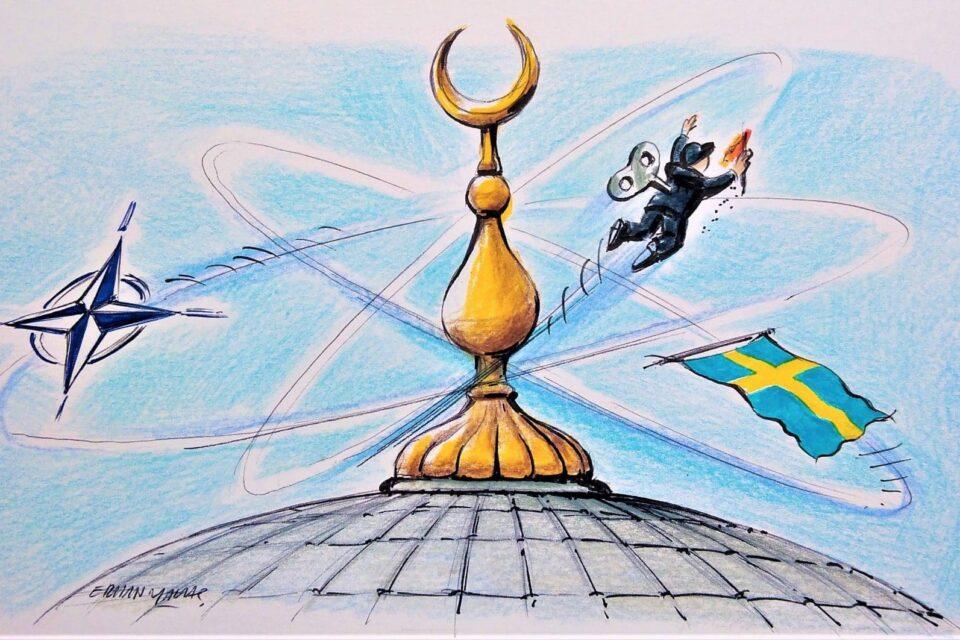
It is no secret that some Western governments have been unhappy with Ankara’s autonomous foreign policy in recent years, so some have questioned Türkiye’s NATO membership and policies
Rasmus Paludan, a Danish far-right extremist and racist politician, shamelessly burned a copy of the Quran, the holy book of Islam, to fuel a multidimensional debate on “Islamophobia, the West and Türkiye.”
Let me start by stating that the Swedish authorities violated several United Nations and Council of Europe conventions by letting a hate crime be committed near the Turkish Embassy in Stockholm. That act has nothing to do with democracy or liberties and it promotes Islamophobia, which has transformed the European political mainstream in recent years. Indeed, two days after the original attack, a Dutch far-right politician also burned the Quran. Those developments show that Islamophobia undermines European security and domestic peace. European statesmen should have distanced themselves from Sweden’s problematic approach – as did Türkiye and other Muslim nations. That eerie silence is binding on all of Europe. Fortunately, Johannes Bahrke, a spokesperson for the European Commission, urged the Swedish authorities to take action by saying that there was no room in the European Union for racism, xenophobia or hatred on the basis of race or religion. That warning must not fall on deaf ears.
Sweden: Heart of scandal
Having failed to extradite the Gülenist Terror Group (FETÖ) and PKK terrorists to Türkiye despite making that commitment under the “trilateral memorandum” in Madrid, Sweden allowed an act of provocation to unfold near the Turkish Embassy. The Western media maintained that the country thus “placed at risk” its NATO membership. Turkish news outlets, too, commented that Sweden, which had permitted PKK members to protest in January, did not actually want to join the alliance. It remains unclear who incited the far-right movements or PKK. Yet the Swedish authorities are known to everyone. Let us brush aside some gullible folks, who claim that the Turkish government benefits from such shameless acts, to identify four key repercussions:
1- European governments play a role in spreading anti-Muslim hate crimes.
2- Such developments fuel anti-Westernism among Muslims.
3- Türkiye is more likely to veto Sweden’s NATO membership over that country’s failure to abide by the trilateral memorandum.
4- At the same time, some question Türkiye’s NATO membership and policies.
Those developments provide additional rhetorical ammunition to the Western media, which accuse President Recep Tayyip Erdoğan of bringing Türkiye to “the brink of catastrophe” ahead of this year’s elections.
West unhappy with Türkiye’s autonomy
It is no secret that some Western governments have been unhappy with Türkiye’s autonomous foreign policy in recent years. Ankara risks tensions with Washington and Brussels to defend its national interests. It also develops original policies toward Syria, Libya, Karabakh, the Eastern Mediterranean and the Aegean to ensure its safety and protect its rights. At the same time, the country takes its relations with Russia to a new level as that pendulum swings between competition and cooperation. Türkiye’s attempts to diversify and deepen its relations with Russia do not hurt NATO’s interests. Specifically, Ankara does not oppose Sweden and Finland’s admission.
However, it expects those countries to abide by the trilateral memorandum. In light of their failure to keep their promises and Sweden’s current approach, the claim that Erdoğan’s Türkiye blocks NATO’s enlargement makes no sense whatsoever. Indeed, Sweden would be responsible for undermining NATO if delaying the alliance’s enlargement means to weaken it. After all, no NATO ally is in a position to argue that combating terrorism is not important.
The failed policies of the United States and the European Union toward Syria, PKK and FETÖ are among the main reasons why Türkiye needs to have a relationship with Russia on a new level. Today, the Western media experience a contradiction: They concede that Erdoğan seized opportunities in the international arena following the Russian invasion of Ukraine and gained strength in the Balkans, the Black Sea, the Caucasus, Central Asia and Africa. However, at the same time, they criticize the Turkish president for making an impact within the Western alliance.
Under Erdoğan’s leadership, Türkiye went beyond its traditional geopolitical significance as a meeting point of continents. The country is among the world’s rising powers thanks to its new ventures in energy and logistics, its emboldened defense industry, its military presence across the region, and its level of diplomatic activity. What really matters is to acknowledge that originality whilst remaining part of the Western alliance.
You may also like